
Tee Diverter Dampers
TEE DIVERTER DAMPER Design Overview
The diverter is made up of three components: the Tee Box, the Bypass Louver and the HRSG Louver. The louvers are connected to the Bypass and Process (HRSG) outlet connections of the Tee Box. The unit achieves flow diversion by opening and closing the two louvers as needed.
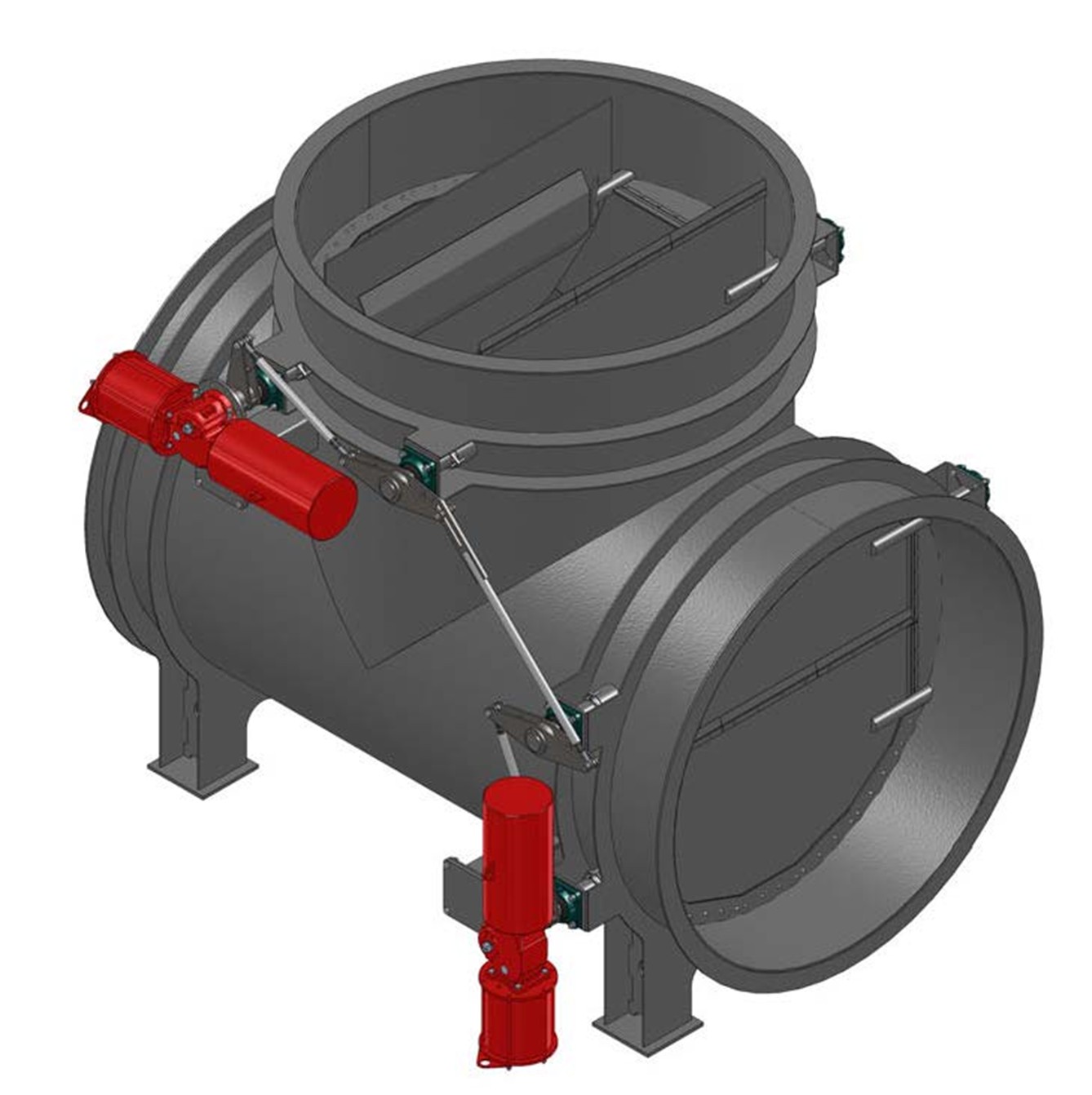
Frame:
The damper frames will be constructed of 304 stainless steel – rolled and flat plates, designed to be alignment bolted and seal welded to the adjoining ductwork (hardware by others). The frame will be designed to resist all loads imposed by shipping, handling and installation, as well as resist all loads imposed by operating conditions. The frames will come with lifting lugs for all field splice sections, as well as completely assembled dampers for field installation.
Insulation: For simplicity and lower cost, the external surfaces of the damper are to be insulated by others. The external damper components will have enough clearance to allow up to 6” of insulation. All method of attaching the insulation to the damper will be by others, but we can provide detail sketches on how to insulate at bearings and other protrusions.
HRSG And Bypass Louver Blade:
The Bypass louver blades are of an offset airfoil design. The smooth airfoil design, made of a bottom flat plate and bent stiffener plate, affords the lowest pressure drop with a greater section modulus. The blade is of welded construction for strength and stability. The damper blades are designed to limit their deflection to the lesser of 1/360 of the span or 1/4” under the maximum operating conditions. Stresses are limited to 2/3 the yield strength at design temperature and pressure.
The blades will be fabricated from 304 stainless steel, and each blade will be provided with position indicator arrows at the idler shaft end. Both the Bypass and HRSG ports will have (2) blades arranged in opposed action for tight shut-off with effective flow modulation.
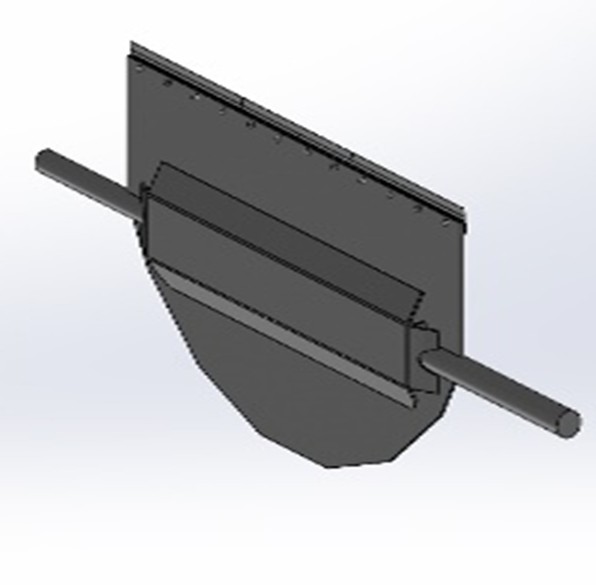
Seals:
Sealing is accomplished by utilizing SFP-Metroflex’s reinforced, flexible metallic “Tip-style” spring seals at both the frame perimeter and along the edge of one blade at each damper. (The blade tip seals are oriented downstream of the flow when opening. These leaf-seals provide tight shutoff while creating minimal pressure drop.
All seals will be fabricated from I625 alloy. These seals allow for significant thermal expansion while maintaining metal to metal contact, allowing for tight shut-off over a large temperature range.
Shafts:
The blade stub shafts are of machined 304 stainless steel. The stub shafts will be welded directly to the blade to form a uniform axle with the blade and stiffener. The shafts are designed for a maximum of 1/3 yield stress in torsion and 2/3 yield stress in combined bending and torsion.
Bearings:
The exterior bearings will be pedestal mounted, flanged, permanently lubricated, self-aligning bearings. The bearings will be located adjacent to the packing to minimize deflection.
Packing:
To protect the bearings from contamination and to prevent flue gases from exiting the damper, the frame is sealed with packing glands. The glands are continuously welded to the damper frames at each shaft penetration. The packing is 100% asbestos free; graphite rope consisting of compressed rings to reduce leakage to atmosphere. Compression is obtained through an adjustable free floating, self-aligning packing follower.
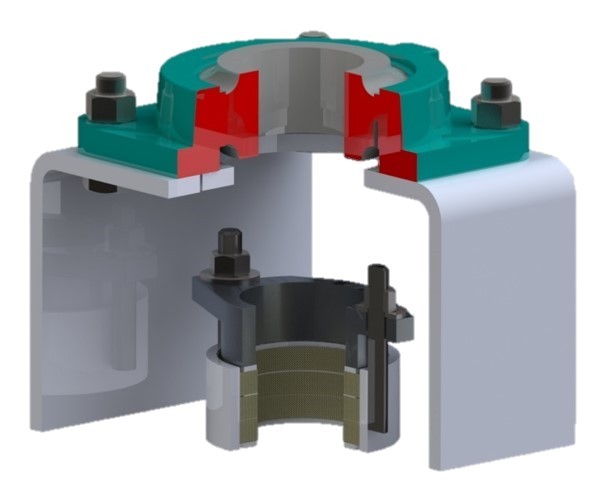
Linking & Actuation:
IThe opposing type linkage will be of a compensating, adjustable, locking turnbuckle design, using spherical rod ends. This design is used to eliminate binding or increases in torque requirements due to thermal growth and to assure blade sealing efficiency. All connections will be precision fit to assure accurate blade adjustment and alignment and to eliminate blade flutter.
The Bypass and HRSG louver banks are connected by a slip-linkage rod. This allows them to be no more than 50% out of synchronicity should the individual actuators lag between each other in operation, and thus prevents the accidental closure of both damper outlets.
Design Data:
Design Temperature: 1,100˚ F
Design Pressure: 2 PSIG (55.4” W.C.)
Design Exhaust Flow: 412, 972 lb/hr
Normal Operating Pressure: 15” W.C.
Damper Duty: Modulating Duty and Shutoff
Rated Leakage: <0.5% of flow
Standard Shop Testing:
Each damper will undergo our standard, operational shop test, which includes inspection, dimensional and fit-up verification and damper operation via the actuator- open/close five times, and undergo a standard “gap map” to verify sealing performance per AMCA guidelines.
The diverter will undergo a complete operational test prior to shipment. The unit will be stroked using the supplied actuator to ensure complete functionality, open and close 3 times. Testing will be conducted at Ambient conditions in horizontal position.
The seal efficiency of the Louver banks will be verified by gap measurement.
Instrumentation: No additional instrumentation has been provided. See Actuation section for Open/Close Limit switches and position transmitter information.
Paint: NONE REQUIRED, Stainless Steel Construction.
Actuators, seal air fans, valves, will come their manufacturers’ standard for the application.
Non Destructive Examination: Each damper will undergo the following NDE at our facility prior to shipment.
All welds: 100% visual examination per AWS D1.1
Welding: All welding will be done per ASME Section IX.