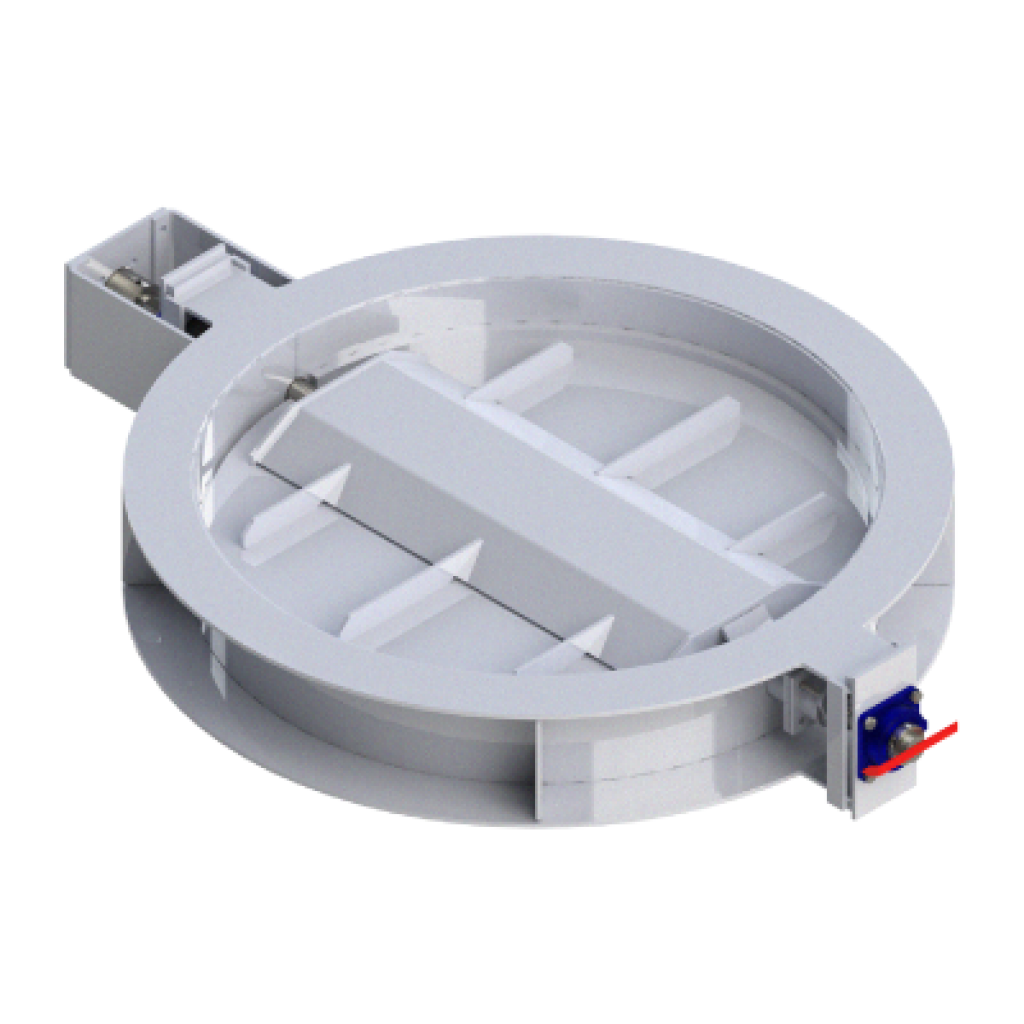
Stack Damper Kit
STACK DAMPER KIT Design Overview
Frameless Construction: The damper components (bearing/packing assemblies/actuator/etc) will be directly assembled to the existing stack shell with external reinforcements for new damper loads. Blade components will be assembled, and then welded within the stack, and rainwater-draining blade seats will be installed after final assembly
Blades: The (4) blades are an offset airfoil design. The smooth airfoil design, made of a bottom flat plate and bent stiffener plate, affords the lowest pressure drop with a greater section modulus. The blade is of welded construction for strength and stability. The offset airfoil design is more than 15% stronger than comparable symmetrical designs. The damper blades are designed to limit their deflection under the maximum operating conditions. Stresses are limited to 2/3 the yield strength at design temperature and pressure. All shaft to blade connections are welded for maximum torque transmission and to eliminate the possibility of blade flutter from flow medium velocity in control applications. The blades will be alignment bolted, installed in their final position, adjusted, and then welded (work by others).
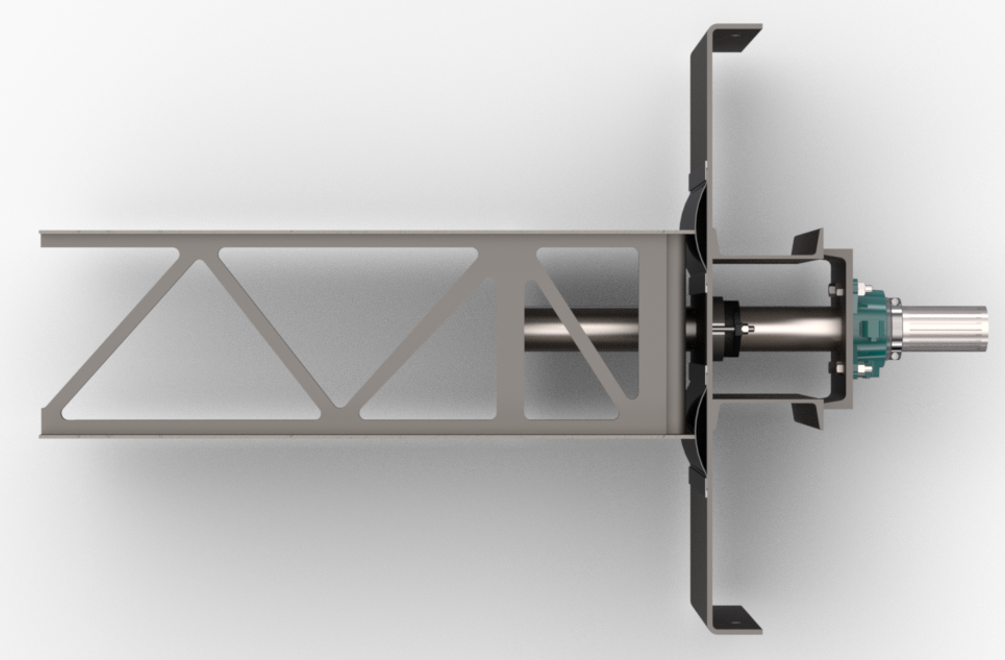
Shafts: The blade stub shafts are of machined stainless steel. The stub shafts will be welded directly to the blade to form a uniform axle with the blade and stiffener. The shafts are designed for a maximum of 1/3 yield stress in torsion and 2/3 yield stress in combined bending and torsion. Each blade will have an external indicator welded to the end of the idler shaft to show blade position. The shafts are locked with shaft collars on the drive side of the frame to allow for thermal expansion and contraction through the idler bearing.
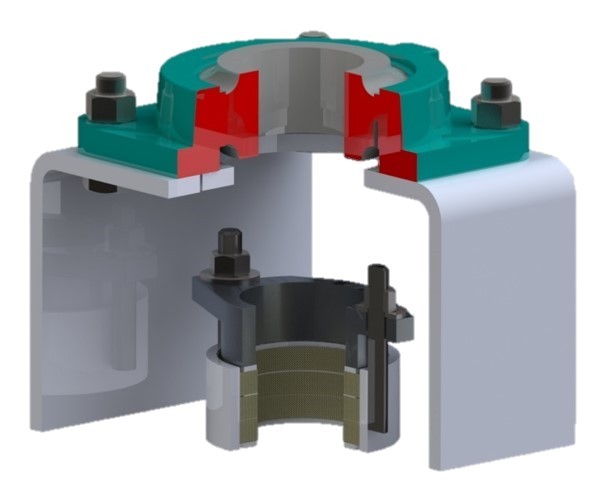
Bearings: The bearings are a highly efficient, low maintenance, self-aligning, sleeve bearings, specifically designed for this type of application. The louver damper bearing is a pedestal mounted flanged unit of materials requiring no additional lubrication. In many instances, because the shaft travel is only 90 degrees, when bearing wear is experienced, the bearing simply has to be rotated 90 degrees, thereby exposing a new quadrant to wear.
Packing Assembly: To protect the bearings from contamination and to prevent flue gases from exiting the dampers, the frames are sealed with packing glands. The glands are continuously welded to the damper frames at each shaft penetration. The packing is 100% asbestos free; Teflon rope. Teflon provides a major reduction in packing friction when compared to ceramic or graphite rope. Compression is obtained through an adjustable free floating, self-aligning packing follower.
Blade and Periphery Seals: The Stack Isolation louver damper will have Pathway Metroflex Step periphery and Blade Seats. The Step seat consists of a flat bar that contact the blades in the closed position. The blades will overlap each other by at least ½” to help eliminate cross blade leakage. The flat bar seat funnels rainwater to (2) perimeter 2” drain connections. Drainage piping to grade is considered “by others”.
Actuator: We are providing electric actuation with a 200% design safety factor based on all live and dead loads. The actuator will come equipped per the following:
- 15 Minute duty motor
- 2 counter gear driven limit switches
- Open/close torque switches
- Space heater in the switch compartment
- Plug and socket electrical connection
- Side mounted hand wheel override
- NEMA 4X/6 enclosure
- Auma Matic Integral motor control interface board with a 120V optically isolated input, 3 pushbuttons (O-S-C), 3 indicating lights and selector switch (L-O-R), and integral motor starters (vendors std.).
Linkage: The linkage will be of a compensating, adjustable, locking turnbuckle design, using spherical rod ends. This design is used to eliminate binding or increases in torque requirements due to thermal growth and to assure blade sealing efficiency. All connections will be precision fit to assure accurate blade adjustment and alignment and to eliminate blade flutter. The linkage will be designed with a 2 to 1 safety factor when calculating for buckling stress.
An external blade lock has been included on the drive blade for the closed position. We have not included locks on each individual blade.
Escapement Mechanism: Over-pressurization protection is provided through the use of our actuator de-clutching mechanism. This mechanism allows the damper blades to partially open at a design pressure of approximately 5”w.c. without the use of the damper’s actuator by using an offset blade design.
External Limit Switches: Each damper will be provided with a limit switch enclosure which includes (4) adjustable end of travel switches.
Standard Shop Testing: includes inspection, dimensional and fit-up verification and damper operation via the actuator- open/close five times, and undergo a standard “gap map” to verify sealing performance per AMCA guidelines.
Standard Shop Testing: Each damper will undergo our standard, and fit-up verification and bench testing the actuator – open/close three times.
Instrumentation: No additional instrumentation has been provided. See Actuation section for Open/Close Limit switches and position transmitter information.
Paint: TBD
Actuators, seal air fans, valves, will come their manufacturers’ standard for the application.
Non Destructive Examination: Each damper will undergo the following NDE at our facility prior to shipment.
All welds: 100% visual examination per AWS D1.1
Welding: All welding will be done per ASME Section IX.
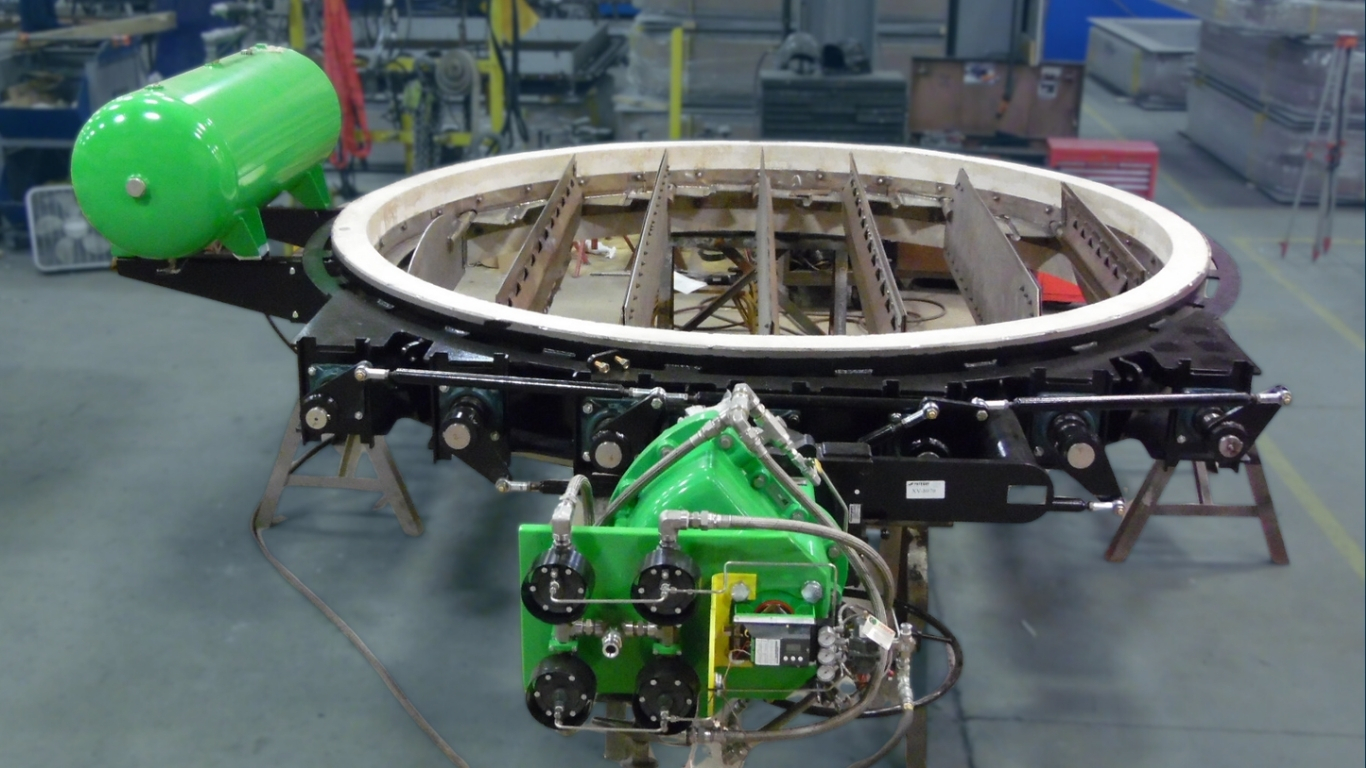
Industrial Applications
In power generation, they serve an essential role in controlling flue gases and ventilation within boilers and exhaust systems. Chemical and petrochemical plants rely on these dampers to manage toxic or volatile gas flows, contributing to both process efficiency and safety. Cement and mining industries employ butterfly dampers in dust collection and air handling systems, where reliability under harsh conditions is paramount. Additionally, food and beverage processors use them in sanitation-sensitive air control applications, and HVAC systems across commercial and institutional buildings benefit from their energy-efficient operation.
Butterfly Damper Fit:
- Attached or linked to piping/duct flanges or directly to duct.
- Flange connections may be alignment bolted and seal welded into the duct, or provided with bolt and gasket type connections.
- Butterfly dampers typically require between 8”-12” of duct space for installation.
Butterfly Damper Form:
- Butterfly dampers are used for duct isolation and flow control.
Butterfly Damper Function:
- Open/close applications where less than 99.5% isolation is acceptable
- Flow control/modulation