
Frequently Ask Questions (FAQ)
What is an expansion joint?
A piping expansion joint is an engineered component within piping systems designed to absorb piping movements. An expansion joint contains one or more bellows to absorb the movement. The directions of movement could be axial, lateral, angular, or a combination. The source of movement could be from thermal expansion or contraction, vibration or seismic, or any other form. The flexible portion of the expansion joint could be made from metal or non-metallic (fabric or rubber).
What is a bellows?
A piping expansion joint is an engineered component within piping systems designed to absorb piping movements. An expansion joint contains one or more bellows to absorb the movement. The directions of movement could be axial, lateral, angular, or a combination. The source of movement could be from thermal expansion or contraction, vibration or seismic, or any other form. The flexible portion of the expansion joint could be made from metal or non-metallic (fabric or rubber).
What movements can a piping expansion joint absorb?
An expansion joint can be designed to absorb axial, both compression and extension, lateral and angular movements. Torsional movement, around the axis of a round bellows, can be absorbed but is strongly not recommended. Some movements may not be possible when certain hardware is present that limits the degrees of freedom, such as tie rods, hinges and gimbals.
What is an axial movement?
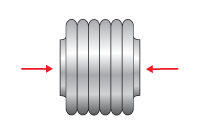
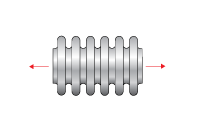
Axial is the shortening (compression) or lengthening (extension) of the bellows along its longitudinal axis. The inlet and outlet face of the bellows remain parallel during the movement.
What is an angular movement?
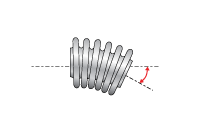
Angular movement is the displacement of the straight longitudinal axis of the bellows into a circular arc shape. Sometimes called a rotational movement. The ends of the bellows are no longer parallel when an angular movement is applied. Rotation about the longitudinal axis of the bellows is not an angular movement and is referred to as torsion.
What is a lateral movement?
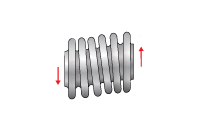
Displacement of the ends of the bellows such that they are no longer colinear, but the ends of the bellows remain parallel. Large lateral movements or large diameter bellows often require a universal expansion joint to accomplish the lateral movement. In the case of a universal expansion joint deflected into a lateral movement, each bellows performs an angular movement. (include link to universal definition).
What is a torsional movement?
Torsion is rotation about the longitudinal axis of the bellows and is not an acceptable movement or acceptable use of a metal bellows. Torsion and torsional loads should be avoided or restrained by piping with anchors or external expansion joint hardware.
What is a single expansion joint?
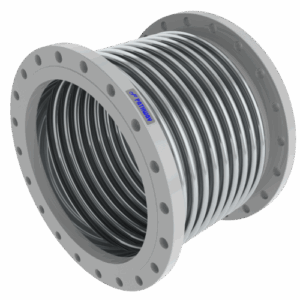
A single is the simplest form of an expansion joint that utilizes one bellows to absorb movements.
What is a universal expansion joint?
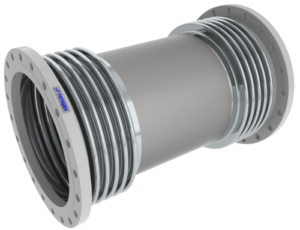
A universal expansion joint is two bellows separated by a pipe spool. The two bellows work in conjunction to absorb movements. Sometimes referred to as a double expansion joint. Universal expansion joints are common when large lateral movements are required or when large diameter bellows are required.
Metal Bellows Expansion Joint Design Basics
Metal bellows expansion joints consist of a flexible bellows element, appropriate end fittings such as flanges or butt-weld ends to allow connection to the adjacent piping or equipment, and other accessory items that may be required for a particular service application. Bellows are manufactured from thin-walled tubing to form a corrugated cylinder. The corrugations, commonly referred to as convolutions, add the structural reinforcement necessary for the thin-wall material to contain system pressure. The bellows designer selects the thickness and convolution geometry to produce a bellows design that meets the system pressure and temperature requirements, as well as being suitable for the movements required.
Flexibility of the bellows is achieved through bending of the convolutions. In most cases, multiple convolutions are required to provide sufficient flexibility to accommodate the required movements, but a single convolution may be suitable for small amounts of axial.
FATIGUE LIFE
In most applications, design movements cause the individual convolutions to deflect beyond their elastic limits, producing fatigue due to plastic deformation, or yielding. One movement cycle occurs each time the expansion joint deflects from the installed length, to the operating temperature position, and then back again to the original installation length.
The bellows designer considers such design variables as material type, number of plies, thickness of plies, the number of convolutions and their geometry to produce a reliable design for the intended service with a suitable cycle life expectancy.
PRESSURE INSTABILITY – SQUIRM
There are two different modes of pressure instability, often referred to as squirm. Column instability and inplane instability.
Column instability.
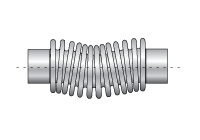
An internally pressurized bellows behaves like a slender column under compressive load. At some critical end load, the column will buckle. In a similar fashion, at a sufficient pressure, an internally pressurized bellows that is installed between fixed points will also buckle, or squirm. The failure is identified as a gross lateral shift of the convolutions off of the longitudinal centerline. Bellows squirm will reduce the service and fatigue life, or in extreme cases, produce a catastrophic failure. To avoid squirm, the bellows designer must limit movement capacity and flexibility to a level that ensures that the bellows retains a conservative margin of column stability beyond the required design pressure. This form of pressure instability is mainly limited to bellows with a higher L/D ratio, much like the column buckling.
For most applications, the ends of the expansion joint are assumed to be fixed-fixed. The column instability pressure is lowered if the ends are not fixed-fixed.
Inplane instability
Another form of pressure instability is inplane squirm. Inplane squirm is characterized by a movement of one or more convolutions such that the plane of the convolution no longer lies in a single plane and is not perpendicular to the axis of the bellows. The convolution(s) often look tilted or warped. While this form of instability is more common in bellows with small L/D ratios, it can occur in any bellows.
STIFFNESS OR SPRING RATES
Expansion joints behave in a manner that is similar to a spring; as movement occurs, the bellows produce a resistive force. This resistance is stated as a stiffness or spring rate. The resulting spring force is obtained by multiplying the appropriate spring rate times the deflection.
When external hardware is present on the expansion joint, such as tie rods, hinge/gimbal, the assembly spring rate will be different than the bellows stiffness alone. When movement is restricted in a direction, such as when a hinge is present, the assembly stiffness in that direction will be a combination of the bellows and the hardware.
PRESSURE THRUST
If we consider a pipe section with blind flanges attached at each end, it is obvious that internal pressure produces a thrust force against the flange surfaces in opposing directions, however the longitudinal rigidity of the pipe prevents significant or appreciable elongation. Since the pipe axial spring rate or axial stiffness is very high.
When an unrestrained expansion joint is added into the same pipe, this axial rigidity is significantly reduced to that of the bellows. As pressure increases, the pressure thrust force may overcome the axial spring resistance of the bellows, producing significant elongation and possibly unconvoluting the bellows. This lowers the pressure capacity and movement capacity of the bellows and can result in failure. The pressure thrust force produced is equal to the differential internal pressure multiplied by the effective area of the bellows. This will cause the flexible bellows to extend outward unless it is restrained. In most pressure piping applications, pressure thrust is usually much greater than spring force.