
Tandem Louvre Dampers
Sealing redunancy for critical flow control
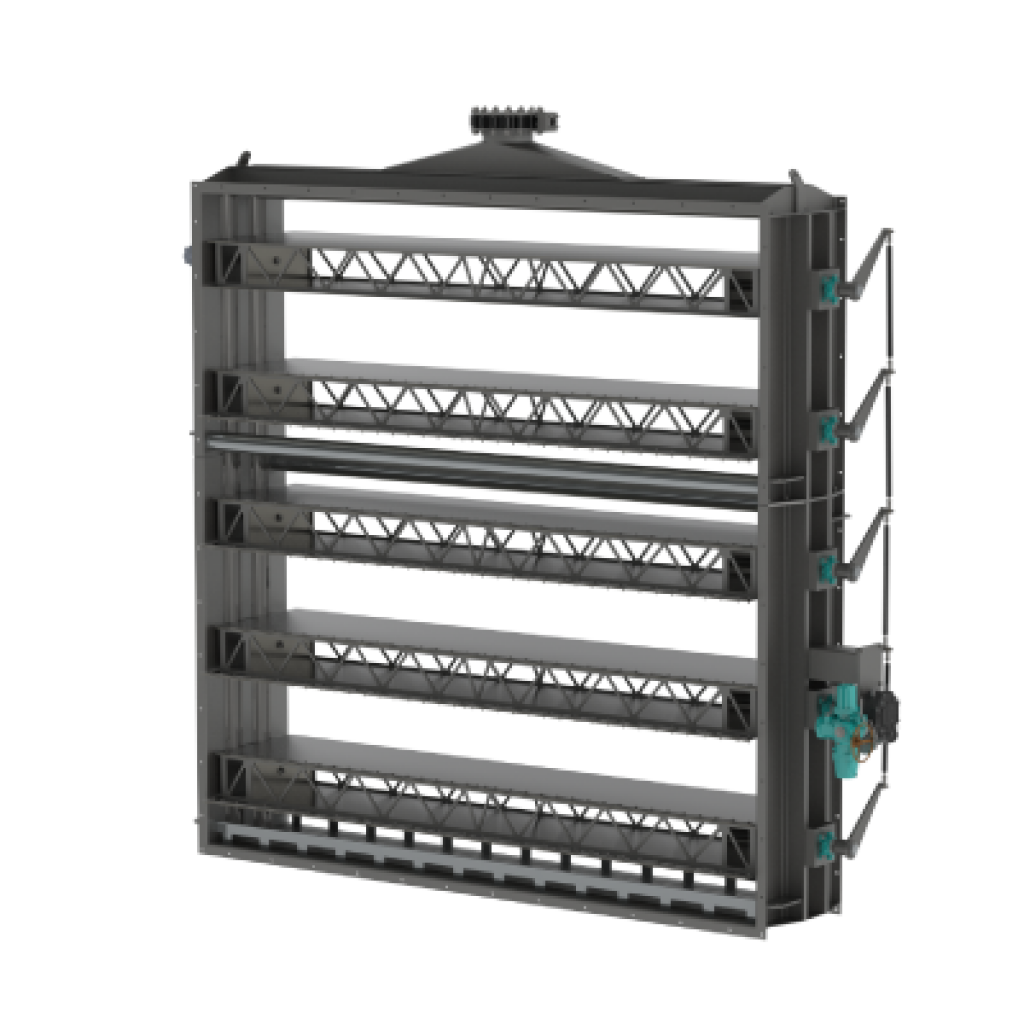
Industrial tandem louvre dampers are specialized flow control devices featuring two interconnected damper blades or disks, typically arranged in series within ductwork. This configuration is designed to provide enhanced sealing and precise regulation of air, gas, or particulate streams, especially in applications where absolute isolation or zero leakage is required. Tandem dampers are commonly used in industries such as power generation, chemical processing, and mining, where maintaining strict process control and safety standards is critical.
The tandem design enables redundancy; if one damper fails to seal, the second provides backup, improving operational reliability. These dampers often incorporate robust actuators and advanced sealing technologies, ensuring optimal performance even under high temperature, corrosive, or abrasive conditions. Their use is particularly advantageous in systems requiring frequent isolation for maintenance or emergency shutdowns, as well as in environments subject to stringent environmental regulations.
Tandem Louvre Damper Fit:
- Attached or linked to piping/duct flanges or directly to duct.
- Flange connections may be alignment bolted and seal welded into the duct, or provided with bolt and gasket type connections.
- Tandem louver dampers typically require between 36”-48” of duct space for installation.
Tandem Louvre Form:
- Flex-Ledge Tandem louvers are used for 100% isolation of ductwork.
Tandem Louvre Damper Function:
- Open/close applications where tight shutoff is mandatory.
- Often 100% isolation required with seal air systems
- Provides “man-safe” isolation of equipment for online maintenance
- Allows for “fast acting” operation (<20 seconds) for emergency bypass applications.
Industrial Applications
In power generation, they serve an essential role in controlling flue gases and ventilation within boilers and exhaust systems. Chemical and petrochemical plants rely on these dampers to manage toxic or volatile gas flows, contributing to both process efficiency and safety. Cement and mining industries employ butterfly dampers in dust collection and air handling systems, where reliability under harsh conditions is paramount. Additionally, food and beverage processors use them in sanitation-sensitive air control applications, and HVAC systems across commercial and institutional buildings benefit from their energy-efficient operation.
Features
- Multiple linkage and sealing arrangements for both flow control and isolation, with 100% isolation options available.
- Many different actuator options to fit customer’s operating requirements.
Applications
- Typically used for isolation only.
- Typically used for isolation up to 99.5%
- 100% isolation can be achieved using a supplied seal air system.
Operating Range
- 0-50 psig depending on size
- -100 to 2000°F
- Sizes from 12” > 10’
- Horizontal or vertical
Materials
- Carbon Steel
- Stainless Steel
- Nickel Alloys