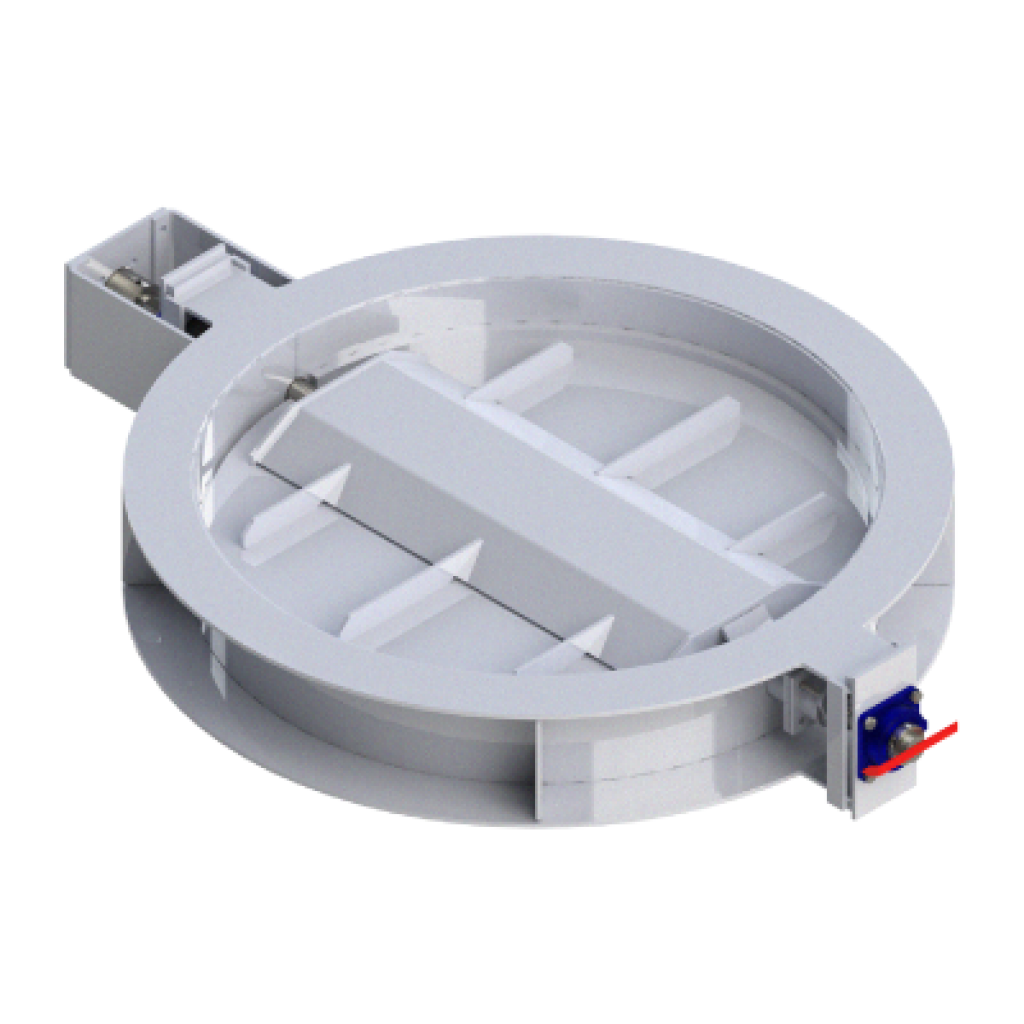
Stack Dampers
Stack Damper Design Overview
The Engineering of stack dampers must consider durability, efficiency, and adaptability. Stainless steel and galvanized metal materials are often chosen for their resistance to heat and corrosion. Structural integrity is critical as stack dampers must withstand both the physical stresses of airflow and the thermal expansion caused by temperature fluctuations.
Mechanical design is another crucial factor. Damper blades are typically engineered with aerodynamic profiles to minimize turbulence and maintain steady airflow. The actuating mechanisms must provide precise control and swift response to ensure optimal performance. Engineers also focus on sealing and insulation to prevent unwanted heat loss and minimize leakage, which directly impacts energy efficiency.
Integration with system controls is key. Modern stack dampers are often equipped with sensors and feedback loops that communicate with building management systems, allowing for automated adjustment based on real-time conditions. Safety features, such as fail-safe positions and fire-rated components, are incorporated to comply with regulatory standards and protect both equipment and occupants.
Ultimately, the engineering of stack dampers is driven by the need for robust, reliable operation under demanding conditions, seamless integration with other systems, and the flexibility to accommodate varying application requirements.
Frame:
The damper frame will be constructed from an externally stiffened 3/8” thick A36 spool with weld prepped ends designed to be welded in the field (optional pricing has been given for flanged connections with alignment holes). The frame will be designed to resist all loads imposed by shipping, handling and installation, as well as resist all loads imposed by operating conditions. The frame will be completely self-supporting, requiring no additional support for its accessories. The damper frame incorporates adequate lifting attachments at each corner for field erection. Each fixture is conservatively designed to support the fully assembled damper and its auxiliary components. Temporary shipping braces and supports will be installed if required to prevent permanent distortion and twisting that would be adverse to damper operation.
External damper insulation pins/retainers and external insulation (if necessary) are considered by others.
The frame will also come with (2) capped 6” inspection ports.
Blades: The (4) blades are an offset airfoil design. The smooth airfoil design, made of a bottom flat plate and bent stiffener plate, affords the lowest pressure drop with a greater section modulus. The blade is of welded construction for strength and stability. The offset airfoil design is more than 15% stronger than comparable symmetrical designs. The damper blades are designed to limit their deflection under the maximum operating conditions. Stresses are limited to 2/3 the yield strength at design temperature and pressure. The blades are insulated per the Damper Specifications below.
All shaft to blade connections are welded for maximum torque transmission and to eliminate the possibility of blade flutter from flow medium velocity in control applications.
Shafts: The blade stub shafts are of machined stainless steel. The stub shafts will be welded directly to the blade to form a uniform axle with the blade and stiffener. The shafts are designed for a maximum of 1/3 yield stress in torsion and 2/3 yield stress in combined bending and torsion. Each blade will have an external indicator welded to the end of the idler shaft to show blade position.
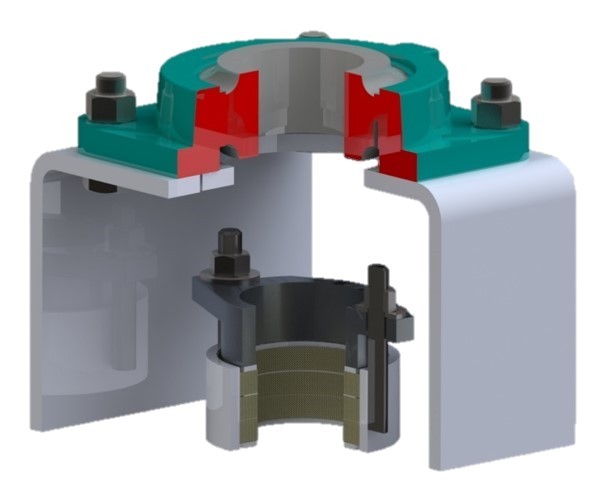
Bearings: The bearings are a highly efficient, low maintenance, self-aligning, sleeve bearings, specifically designed for this type of application. The louver damper bearing is a pedestal mounted flanged unit of materials requiring no additional lubrication. In many instances, because the shaft travel is only 90 degrees, when bearing wear is experienced, the bearing simply has to be rotated 90 degrees, thereby exposing a new quadrant to wear.
Packing Assembly: To protect the bearings from contamination and to prevent flue gases from exiting the dampers, the frames are sealed with packing glands. The glands are continuously welded to the damper frames at each shaft penetration. The packing is 100% asbestos free; Teflon rope. Teflon provides a major reduction in packing friction when compared to ceramic or graphite rope. Compression is obtained through an adjustable free floating, self-aligning packing follower.
Blade and Periphery Seals: The Stack Isolation louver damper will have Pathway Metroflex Step periphery and Blade Seats. The Step seat consists of a flat bar that contact the blades in the closed position. The blades will overlap each other by at least ½” to help eliminate cross blade leakage. The flat bar seat funnels rainwater to (2) perimeter 2” drain connections. Drainage piping to grade is considered “by others”.
Actuator: We are providing electric actuation with a 200% design safety factor based on all live and dead loads. The actuator will come equipped per the following:
460/3/60 power supply; 15 Minute duty motor, NEMA 4X/6 enclosure
- 4 counter gear driven limit switches; Open/close torque switches
- Space heater in the switch compartment
- Side mounted hand wheel override
- 1 Integral motor control interface board with a 24V optically isolated input, 3 pushbuttons (O-S-C), 3 indicating lights and selector switch (L-O-R), and integral motor starters (vendors std.).
- Open /close time: ~30 seconds
Linkage: The linkage will be of a compensating, adjustable, locking turnbuckle design, using spherical rod ends. This design is used to eliminate binding or increases in torque requirements due to thermal growth and to assure blade sealing efficiency. All connections will be precision fit to assure accurate blade adjustment and alignment and to eliminate blade flutter. The linkage will be designed with a 2 to 1 safety factor when calculating for buckling stress.
An external blade lock has been included on the drive blade for the closed position. We have not included locks on each individual blade.
Escapement Mechanism: Over-pressurization protection is provided through the use of our actuator de-clutching mechanism. This mechanism allows the damper blades to partially open at a design pressure of approximately 3”w.c. without the use of the damper’s actuator by using an offset blade design.
External Limit Switches: Each damper will be provided with a limit switch enclosure which includes (4) adjustable end of travel switches.
*We have not include a 4-20mA position transmitter at this time, please clarify if needed.
Standard Shop Testing: Our base proposal includes our standard, operational shop test, which includes inspection, dimensional and fit-up verification and damper operation via actuator – open/close three times. No pressure testing is done at this point.
Personnel Protection: OSHA guarding has been included on the linkage side of the damper only.
Non Destructive Examination: Our base proposal includes the following NDE:
- All welds: 100% visual examination
- Longitudinal butt weld joints in damper shell: RT/UT
- Lifting lugs: PT/MT
Paint and Finish: Before shipment, all external carbon steel surfaces shall be cleaned and painted per system “CP1” of VPI specification V17545-EBNC-0001.
All internal surfaces, stainless steel, and areas within 3” of field weld zones will be left bare.
The actuator will come with its manufacture’s standard paint system for the application.
Preparation for Shipment: The damper will be shipped in halves, shipped in export quality crates
Commissioning: The equipment being proposed requires a significant degree of technical expertise to guarantee its proper installation, and provide you with optimum performance. Please consider your use of SFP-Metroflex technical supervision/commissioning during the installation. Proper installation/commissioning will ensure that 100% of your warranty remains in force. During this trip, a SFP-Metroflex technician will check for proper blade sealing, set actuator limit-switches, and inspect installation to ensure owners long lasting, trouble free operation of the dampers.
Industrial Applications
In power generation, they serve an essential role in controlling flue gases and ventilation within boilers and exhaust systems. Chemical and petrochemical plants rely on these dampers to manage toxic or volatile gas flows, contributing to both process efficiency and safety. Cement and mining industries employ butterfly dampers in dust collection and air handling systems, where reliability under harsh conditions is paramount. Additionally, food and beverage processors use them in sanitation-sensitive air control applications, and HVAC systems across commercial and institutional buildings benefit from their energy-efficient operation.
Butterfly Damper Fit:
- Attached or linked to piping/duct flanges or directly to duct.
- Flange connections may be alignment bolted and seal welded into the duct, or provided with bolt and gasket type connections.
- Butterfly dampers typically require between 8”-12” of duct space for installation.
Butterfly Damper Form:
- Butterfly dampers are used for duct isolation and flow control.
Butterfly Damper Function:
- Open/close applications where less than 99.5% isolation is acceptable
- Flow control/modulation