
RT Expansion Joints
Rectangular Expansion Joints
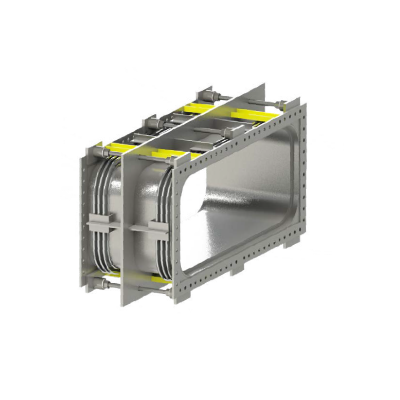
Rectangular expansion joints are specialized components designed to accommodate thermal expansion, contraction, and vibration in ducting systems, particularly those with non-circular cross-sections such as square or rectangular ducts. Unlike round expansion joints, their geometry presents unique engineering challenges, including the need to manage stress concentrations at corners and ensure uniform flexibility throughout the joint. The bellows are typically formed from sheet metal and shaped into a rectangular profile, with reinforcing ribs or corner gussets added to maintain structural integrity and prevent premature fatigue.
Key engineering considerations for rectangular expansion joints include accurate calculation of the bellows’ corrugation profile, wall thickness, and corner reinforcement to withstand operating conditions such as temperature, pressure, and flow-induced vibration. Material selection often favours stainless steel or high-performance alloys for their durability and resistance to corrosion, especially in HVAC, power generation, and industrial process applications. The integration of tie rods, frames, and flanges ensures secure installation and effective movement absorption, while proper gasketing and sealing techniques help maintain system tightness and prevent leakage.
Rectangular expansion joints are widely used in industrial facilities, including HVAC ductwork, exhaust systems, and process piping layouts where space constraints or architectural features dictate non-circular routing. Their ability to accommodate multi-directional movement and reduce transmitted forces helps protect equipment, extend system lifespan, and maintain operational reliability in challenging environments.
Rectangular Expansion Joint Fit:
- Bellows may be attached or linked to angle or plate flanges, or duct sections.
- End connections may conform to ducting sizes, or customer designed
- Fittings may be the same at each end or different.
- Corners are typically 90 degree, but may also be rounded.
Rectangular Expansion Joint Form:
- One or two rectangular flow area metal bellows, each with 1 or more convolutions.
- Typical dimensions of 12” x 12” minimum, up to 240” square. Overall length may vary, typically within the range of 12” to 100”.
- Convolutions are U shaped or V shaped.
- Additional accessories may be incorporated such as load bearing restraints, movement limiters, protection devices.
Rectangular Expansion Joint Function:
- Absorbs ducting thermal movement, primarily axial but may include small lateral and/or angular movements.
- Movement amplitude varies, typically within the range of 1/8” to 8”.
- Movement frequency typically is low cycle (1 to 100 cycles per year).
Industrial Applications
Industries that require rectangular expansion joints in their facilities span a broad spectrum, reflecting the versatility and necessity of these components in complex ducting and piping systems. The HVAC sector is a primary user, especially in large commercial buildings, hospitals, and institutional complexes where ductwork must accommodate movement due to temperature fluctuations and building settlement. Power generation facilities, including both fossil fuel and renewable energy plants, incorporate rectangular expansion joints to manage thermal expansion in boiler exhaust systems and air handling units.
Additionally, the chemical and petrochemical industries rely on these joints in process ductwork to ensure containment and flexibility under varying operating conditions. Pulp and paper mills, steel manufacturing plants, and waste incineration facilities also make extensive use of rectangular expansion joints to protect equipment from thermal stress and vibration. Other applications include tunnel ventilation systems, marine and shipbuilding projects, and food processing plants, where non-circular ducting is dictated by space constraints or specific process requirements. The widespread adoption of rectangular expansion joints across these industries underscores their critical role in maintaining system reliability and operational safety.
Features
Advantages
- Space constraints
Operating Range
Materials
Bellows:
- 3XX Series Stainless Steel
- Nickel Alloys
- Carbon Steel
- Titanium
- Zirconium