
XP Expansion Joints
Externally Pressurized Expansion Joints
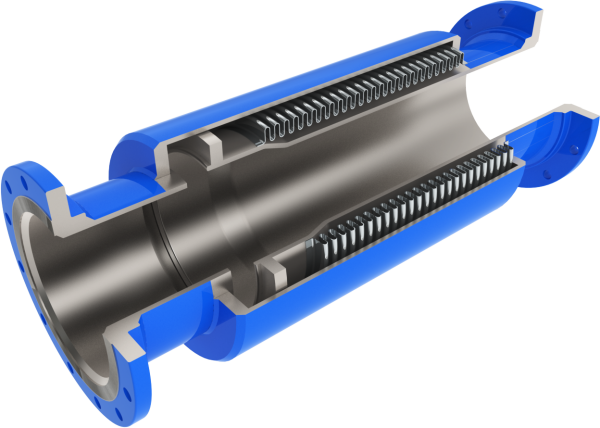
Externally pressurized expansion joints are engineered to accommodate substantial axial movements in piping systems, particularly where long expansion lengths are required and the risk of bellows instability under internal pressure is a concern. Unlike conventional bellows, the pressure in these joints acts on the exterior of the bellows element, which is housed within a protective casing. This configuration ensures that the bellows remains stable even under high pressure, effectively preventing squirm—a form of lateral instability that can compromise performance and safety.
Key engineering considerations include the precise sizing of the bellows and casing, the selection of robust materials such as stainless steel or specialty alloys, and the integration of end fittings like flanges or weld ends for secure attachment. The external pressurization allows for longer stroke capability and higher pressure ratings compared to internally pressurized designs. Additionally, the casing provides mechanical protection against external damage and supports the bellows during operation. These expansion joints are widely used in heating, ventilation, and air conditioning (HVAC) systems, as well as in long pipe runs in power generation, chemical processing, and infrastructure projects throughout the world, where safe and reliable absorption of thermal expansion is essential.
Externally Pressurized Expansion Joint Fit:
- Bellows may be attached or linked to piping flanges, pipe, or other typical industrial connections.
- End connections may conform to standards such as ASME B16.5, ASME B36.10, or customer designed.
- Fittings may be the same at each end or different.
Externally Pressurized Expansion Joint Form:
- Single circular metal bellows, or 1 or more convolutions.
- System pressure is applied to only the outside surface of the bellows.
- Typical dimensions of 2” ANSINPS
to 100” ID. Overall length may vary, typically within the range of 26” to 120”. - Bellows may include reinforcement or controlling members.
- Convolutions are U shaped.
- Additional accessories maybe incorporated such as drains, anchor load bearing restraints.
Externally Pressurized Expansion Joint Function:
- Absorbs piping (thermal) movement, primarily axial but may include small lateral and/or angular movements.
- Movement amplitude varies, typically within the range of 3” to 16”.
- Movement frequency may be extreme low cycle (1 per year), or high cyclic (such as vibration at 60 Hz).
Industrial Applications
Externally pressurized expansion joints are utilized in a range of industry applications where the safe management of significant axial movement and pressure stability is essential. These joints are commonly found in district heating and cooling networks, where long piping runs require reliable absorption of thermal expansion. They are also widely used in HVAC systems for large commercial and institutional buildings, ensuring the integrity of hot water and steam distribution lines. In addition, power generation facilities, chemical processing plants, and infrastructure projects such as tunnels and bridges employ externally pressurized expansion joints to protect piping systems from thermal stress and prevent bellows instability. Their robust design and ability to accommodate long movement strokes make them particularly valuable in situations where space constraints and high pressure are present.
Features
- Used for long axial movements
- Self Draining Convolutions
- Integral cover and liner
- Packless
Applications
- Typically used steam distribution systems and LNG applications
- They can be buried or above ground
- Piping must be properly anchored and guided. Intermediate anchors are required between xpress expansion joints.
Operating Range
- Full vacuum to 2000 psig depending on size
- Cryogenic to 1650°F+
- Sizes from 1” NPS to > 240” NPS
Materials
- 3XX Series Stainless Steel
- Nickel Alloys
- Carbon Steel
- Titanium
- Zirconium