
PB Expansion Joint
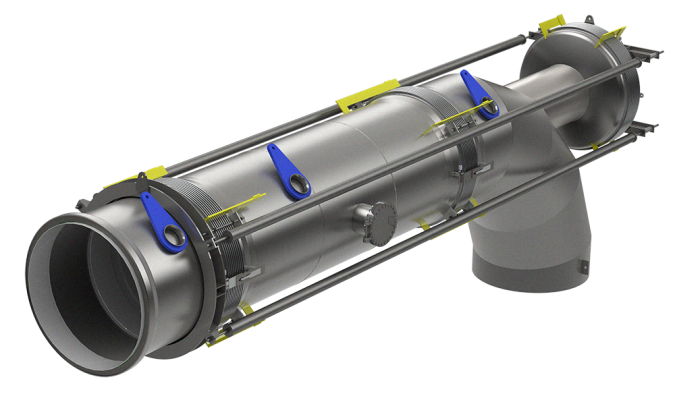
Pressure Balanced Expansion Joint
Pressure balanced bellows are sophisticated expansion joint assemblies engineered to absorb axial and lateral movements while simultaneously balancing the pressure thrust that would otherwise be transmitted to connected equipment. These units typically incorporate one or more bellows and a balancing chamber, arranged so that the internal pressure forces are offset, allowing the joint to accommodate movement without imposing significant load on anchors or supports. This design is particularly advantageous in systems where space or structural limitations prevent the installation of large anchoring structures.
Key engineering considerations for pressure balanced bellows include the precise calculation of bellows geometry, chamber dimensions, and the selection of suitable materials to withstand the operating temperature, pressure, and chemical environment. Stainless steel and high-performance alloys are commonly used for their durability and corrosion resistance. The integration of tie rods and balancing pipes ensures that pressure loads are effectively counteracted, minimizing the risk of system fatigue or failure. Pressure balanced bellows are widely employed in power generation, petrochemical, and heavy industrial applications, providing a reliable solution for managing movement and pressure in complex piping layouts where traditional anchoring methods are impractical.
Pressure Balanced Expansion Joint Fit:
- Attached or linked to piping/duct flanges or directly to duct.
- Flange connections may be alignment bolted and seal welded into the duct, or provided with bolt and gasket type connections.
- Butterfly dampers typically require between 8”-12” of duct space for installation.
Pressure Balanced Expansion Joint Form:
- At least Two circular metal bellows, each with 1 or more convolutions. Can have Four bellows.
- Typical dimensions of 2”ANSI NPS to 120” ID. Overall length may vary, typically within the range of 36” to 240”.
- Bellows may include reinforcement or controlling members.
- Convolutions maybe U shaped or toroidal.
- Additional accessories maybe incorporated such as load bearing restraints, movement limiters, protection devices.
Pressure Balanced Expanion Joint Function:
- Absorbs movement, primarily axial, but may include small amounts of lateral and/or angular movement.
- Use of controlling members, typically tie rods, is required to cancel the bellows pressure thrust forces on adjacent equipment/piping.
(some mes referred to as PA loads). - Movement amplitude varies, typically within the range of 1/4” to 10”.
- Movement frequency may be extreme low cycle (1 per year), or high cyclic (such as vibration at 60 Hz).
Industrial Applications
Pressure balanced bellows are widely applied in situations where it is critical to eliminate pressure thrust loads on sensitive equipment or where pipe anchors and supports cannot withstand significant forces. Common applications include connections to pumps, turbines, and heat exchangers in power generation, chemical processing, and oil and gas facilities. These bellows are also employed in pipeline systems that traverse building structures, bridge crossings, or other areas where anchor points are limited or structural flexibility is required.
In addition, pressure balanced bellows are valuable in HVAC and process ducting for absorbing thermal expansion and vibration without transmitting excessive force to adjoining components. Their ability to manage movement while maintaining system integrity and reducing stress on infrastructure makes them a preferred choice for industrial applications, especially in retrofits or upgrades where space and anchoring options can be restricted.
Features
- Accepts axial, lateral and angular movements.
- Eliminates Pressure Thrust.
Applications
- Pressure balance are used when pressure thrust needs to be eliminated.
- There are two types of PB, with an elbow requires a 90 degree turn in the piping system, and inline can be put in a straight piping system.
Operating Range
- Full vacuum to 2000 psig depending on size.
- Cryogenic to 1650°F+
- Sizes from 1” NPS to > 240” NPS
Materials
Bellows:
- 3XX Series Stainless Steel
- Nickel Alloys
- Carbon Steel
- Titanium
- Zirconium